Salmon DNA facial vs salmon sperm injection: what each puts into the skin
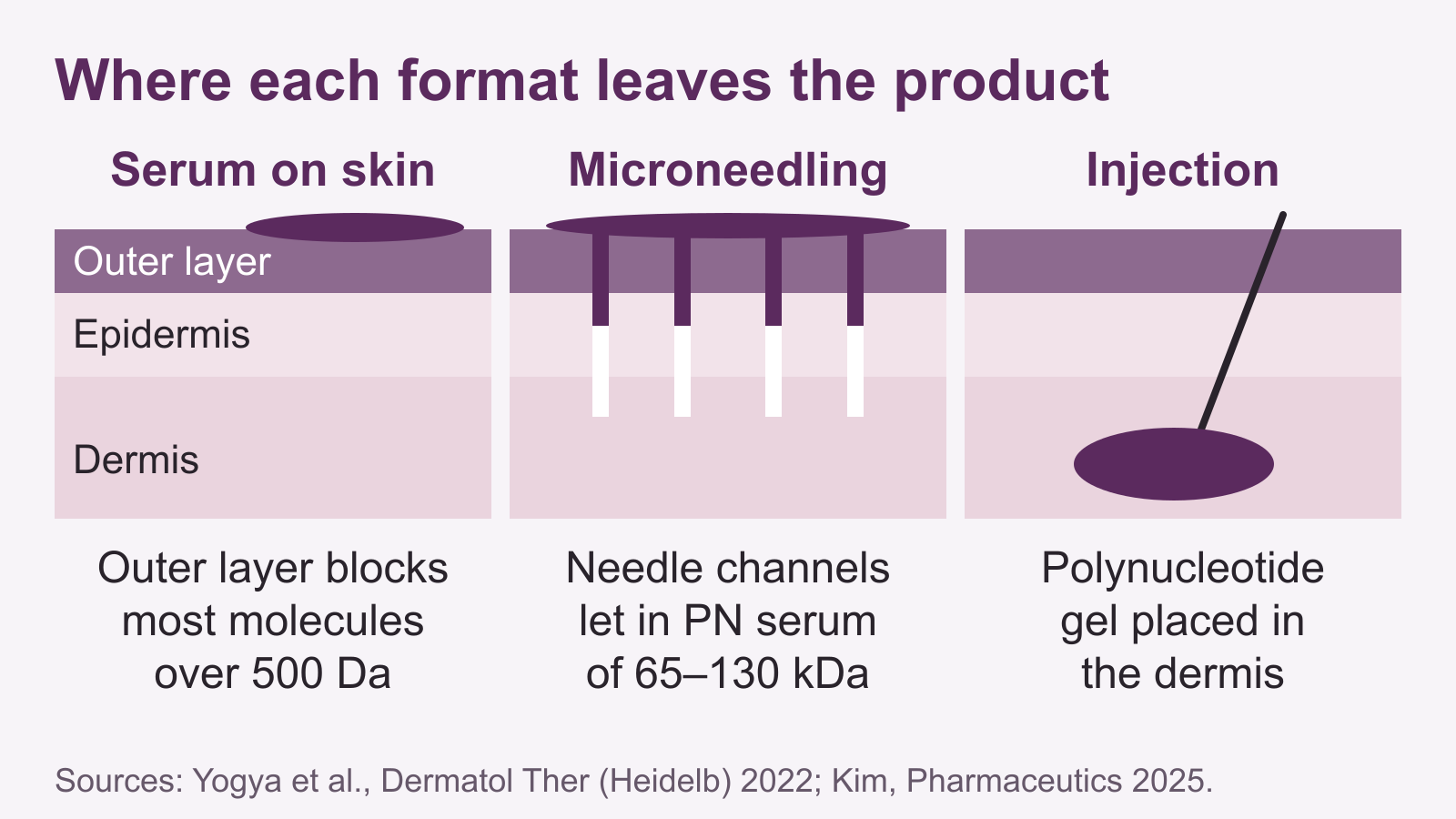
A “salmon DNA facial”, also sold as a salmon sperm facial or PDRN facial, is usually microneedling followed by a serum of DNA fragments spread over the punctured skin. A “salmon sperm injection” places polynucleotide gel into the dermis with a fine needle, as Rejuran does. Both start from fish DNA, but they differ in how deep the product goes, how much is placed and what has been tested: the facial format has two small randomised trials, both run with a microneedling device. The questions to ask differ as well: for a facial, which serum and what needle depth; for an injection, which product and how many cc.
Product notes compiled by the Seoul Skin Boosters editors. Editorially updated: .
Watch the facial and the injection side by side
A cartridge of fine metal needles opens shallow channels in the skin and a drop of DNA-fragment serum spreads over them; then a fine needle places a small polynucleotide deposit in the dermis.
Transcript
- A cartridge of fine metal needles presses into the skin surface.
- The needles lift away, leaving rows of shallow channels.
- A drop of DNA-fragment serum spreads over the channel openings.
- For an injection, a fine needle places a small polynucleotide deposit in the dermis.
- Ask whether the serum is sterile and made for punctured skin.
What happens in a salmon DNA facial?
The name covers a format rather than one product. A microneedling device, a pen or stamp holding an array of fine needles, punctures the skin, and a serum containing DNA fragments, polydeoxyribonucleotide (PDRN) or polynucleotide (PN), is spread over the treated area. In one split-face trial in Thai women, a radiofrequency microneedling tip with 25 needles was set to a depth of 0.8–1.5 mm and passed over the whole face three times; a serum with 0.3% PN, 9 mg in each 3 ml vial, went on one side and saline on the other, and both sides were covered with a clear dressing for an hour [1]. The treatment was repeated three times, two weeks apart.
The needles and the serum are separate products. The FDA’s guidance on microneedling products (accessed 24 October 2026), issued on 10 November 2020, identifies a microneedling device for aesthetic use as “a device using one or more needles to mechanically puncture and injure skin tissue for aesthetic use”. Ask about each one in its own right: the device and its needle depth, and the serum and what is in it.
How far does the serum get?
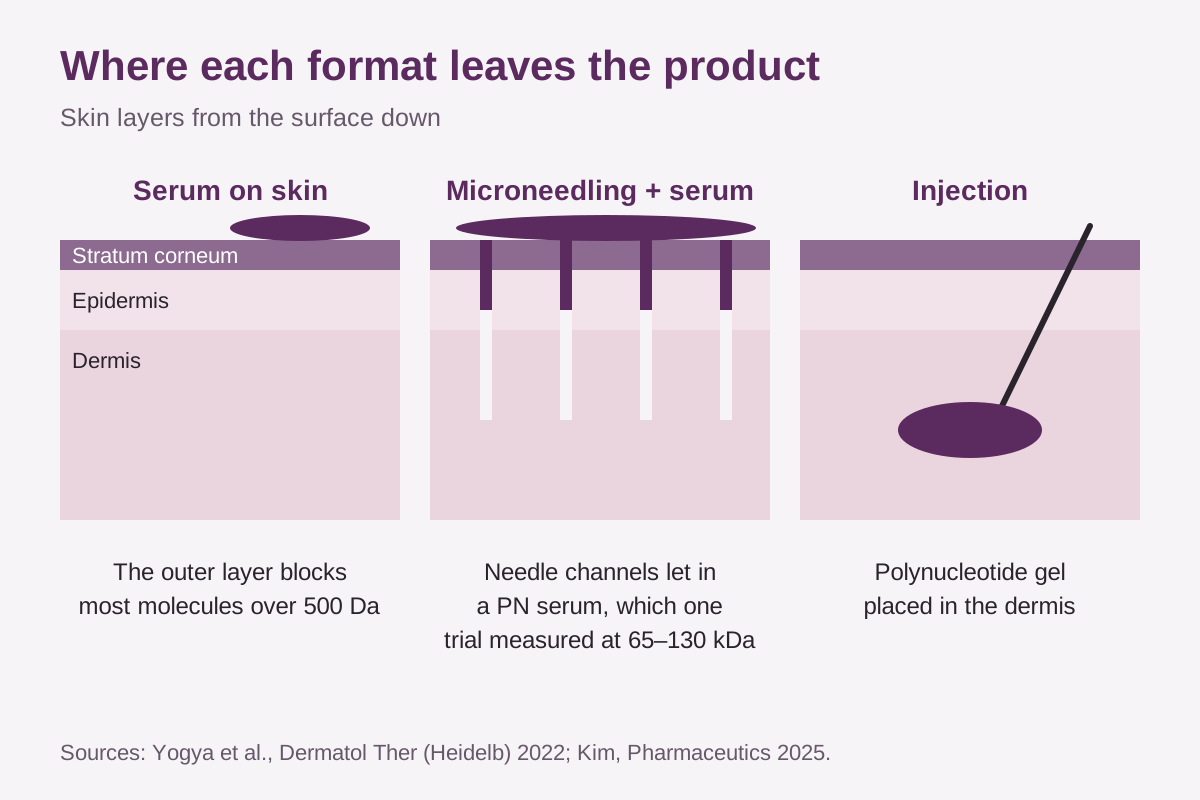
Unbroken skin keeps most of a serum out. The outer layer, the stratum corneum, is nearly impenetrable to most molecules larger than 500 daltons, and the PN in the Thai trial’s serum measured 65–130 kilodaltons [1]. Microneedling opens channels through that layer, which is why the serum goes on straight after the needles. The channels close as debris such as fibrin collects, and the trial authors note that delivery through them works best in the first 30 minutes [1].
What is in the vial?
“Salmon sperm” is meant literally. PDRN is extracted from fish sperm, mainly from salmon trout and chum salmon, and PN from the testes of salmon or trout; PN chains are longer [2]. There is no agreed molecular-weight line between the two, the boundary is often set by each manufacturer, and some products labelled PN have been found on analysis to contain, or consist mainly of, PDRN [2]. On a cosmetic ingredient list, PDRN is usually registered as sodium DNA or hydrolyzed DNA [2].
Not every PDRN serum comes from fish. A 2026 case series used a serum whose PDRN was derived from Lactobacillus sakei, a bacterium [3]. How injected PN and PDRN differ in chain length and proposed action is set out on the Rejuran page.
What did the trials of the facial format find?
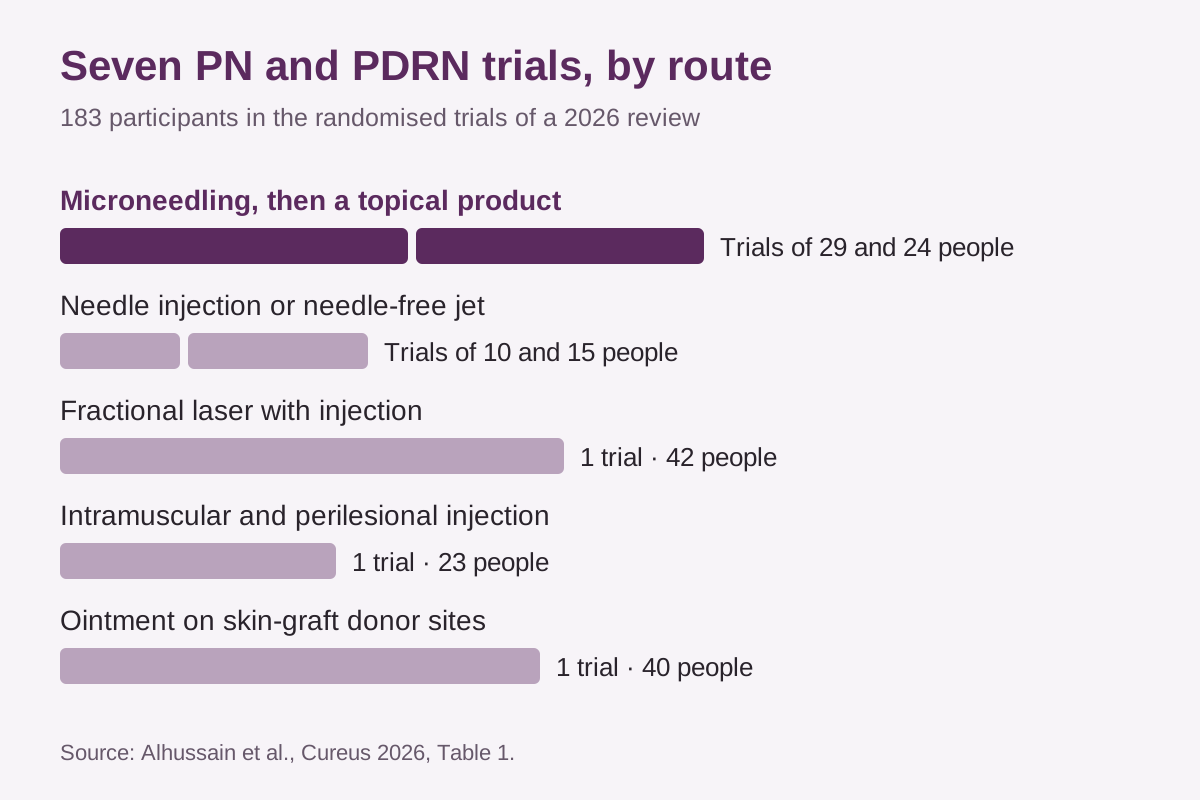
A 2026 systematic review found seven randomised trials of PN or PDRN in skin, with 183 participants in all; two of them tested the facial format, microneedling followed by a topical product [4]. The other five used needle injection or a needle-free jet, fractional laser with injection, intramuscular and perilesional injection for pressure ulcers, or an ointment on skin-graft donor sites.
In the Thai trial, 29 of 30 women completed six months of follow-up. On 3D imaging, wrinkle indentation improved sooner on the PN side, with a statistically significant difference from the saline side at two months; maximum wrinkle depth showed no statistically significant difference between the sides at any visit [1]. Both sides had the same radiofrequency microneedling, so the comparison isolates the serum rather than the whole facial.
The second trial, summarised in the review, treated 24 women with microneedling plus either a 3% salmon PDRN solution or platelet-rich plasma (PRP). Over six weeks, the mean Lemperle wrinkle score fell from 2.33 to 1.00 in the PDRN group and from 2.33 to 1.50 in the PRP group, a statistically significant difference in favour of PDRN; a pigmentation index fell in both groups with no statistically significant difference between them [4].
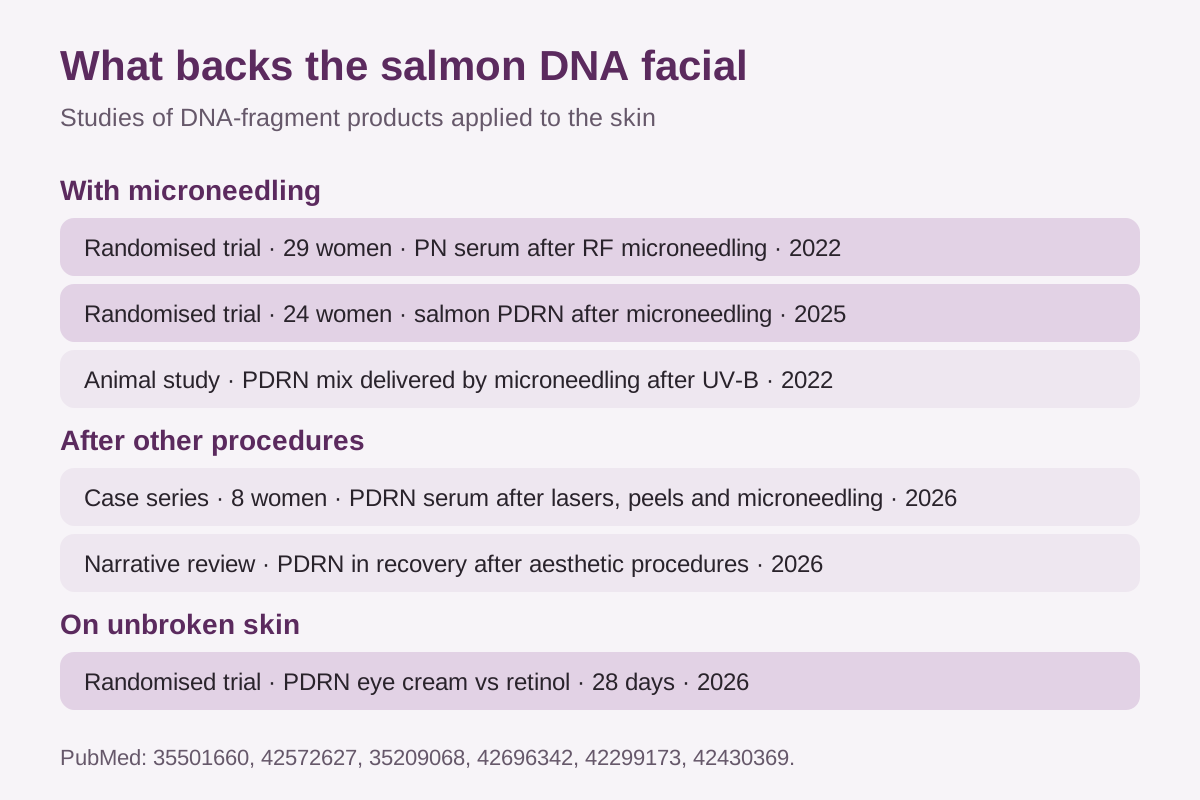
The rest of the facial evidence is of other kinds. A 2026 narrative review proposes PDRN as an add-on after laser resurfacing, peels, microneedling and radiofrequency [5]; a 2026 case series describes eight women who used a PDRN serum after procedures that included microneedling [3]; a 2022 study delivered a PDRN, vitamin C and niacinamide mix by microneedling in animals exposed to UV-B [6]; and a 28-day split-face trial compared a PDRN eye cream with retinol on unbroken skin, with authors from two biotechnology companies [7].
How is the injection different?
A salmon sperm injection is a different kind of product. Polynucleotide gel such as Rejuran is injected into the dermis with a fine needle [2], so the amount per session is measured in cc rather than left to what passes through channels; its variants, records, trials and Seoul prices are on the Rejuran guide.
What can go wrong with a facial?
Whatever is on the skin during microneedling can be carried into it. A 2014 report described three women who developed granulomas on the face after microneedling for skin rejuvenation; two had the same vitamin C serum applied during treatment, and biopsies showed foreign-body granulomas [8]. The authors concluded that topical products applied before microneedling can introduce immunogenic particles into the dermis. In the four skin-rejuvenation trials in the 2026 review, which include both facial-format trials, local reactions were mostly mild and short-lived and no serious adverse event was reported [4].
Questions to ask before a facial
- Which serum will be used, and can you show me the box or vial with its ingredient list?
- Which device will be used, and what needle depth is set for my face?
- How many sessions are planned, how far apart, and what is the total?
Facial or injection: how to decide
The two formats answer different questions. A facial puts a serum on skin opened by needles; how much gets in depends on the device, the depth and the timing, and the trial evidence comes from two small studies. An injection places a measured amount of polynucleotide in the dermis and has its own product records and trials. A serum or cream used at home works on unbroken skin, and how home creams and devices compare with injected boosters is a separate question.
Is a salmon sperm facial really made from sperm?
Is a salmon DNA facial the same as Rejuran?
No. Rejuran is a polynucleotide gel injected into the dermis with a needle; a facial spreads a serum over skin opened by microneedling. The two trials of the facial format used serums, not an injectable gel [4].
How many facial sessions did the trials use?
Does a salmon DNA facial hurt?
In the Thai trial, numbing cream went on under occlusion for an hour first, and mean pain for the procedure was 2.2 out of 10 [1]. Ask which numbing method and needle depth are planned for you.
What does PDRN look like on an ingredient list?
In cosmetics it is usually registered as sodium DNA or hydrolyzed DNA [2]. Ask to see the list before a facial so you know what goes on the punctured skin.
References (8)
Bibliographic records retrieved from PubMed (U.S. National Library of Medicine).
Yogya Y, Wanitphakdeedecha R, Wongdama S, et al. Efficacy and Safety of Using Noninsulated Microneedle Radiofrequency Alone versus in Combination with Polynucleotides for Treatment of Periorbital Wrinkles. Dermatol Ther (Heidelb). 2022;12(5):1133-1145.
PubMed: 35501660Kim ST. Comparison of Polynucleotide and Polydeoxyribonucleotide in Dermatology: Molecular Mechanisms and Clinical Perspectives. Pharmaceutics. 2025;17(8).
PubMed: 40871045Wu Y, Guénin S, Fung E, et al. Real-World Cases Using Phyto Polydeoxyribonucleotide (PDRN) Serum. J Drugs Dermatol. 2026;25(9):15491s2-15491s14.
PubMed: 42696342Alhussain AM, Turki M Albusayys S, Alfhadi MA, et al. Polynucleotides and Polydeoxyribonucleotides for Skin Rejuvenation, Postoperative Scar Prevention, and Wound Healing: A Systematic Review of Randomized Clinical Trials. Cureus. 2026;18(7):e112403.
PubMed: 42572627Flores Rodríguez JC, Toledo Avelar LE, Yi K, et al. Polydeoxyribonucleotide (PDRN) in Post-procedure Recovery in Aesthetic Medicine: A Narrative Review. Cureus. 2026;18(5):e108886.
PubMed: 42299173Kim HM, Byun KA, Oh S, et al. A Mixture of Topical Forms of Polydeoxyribonucleotide, Vitamin C, and Niacinamide Attenuated Skin Pigmentation and Increased Skin Elasticity by Modulating Nuclear Factor Erythroid 2-like 2. Molecules. 2022;27(4).
PubMed: 35209068Ye R, Wang Q, Du L, Li L, Hu F. Topical medium-length PDRN enhances dermal extracellular matrix repair in photodamaged skin via PI3K-Akt/TGF-β-regulated pathways. PLoS One. 2026;21(7):e0350905.
PubMed: 42430369Soltani-Arabshahi R, Wong JW, Duffy KL, Powell DL. Facial allergic granulomatous reaction and systemic hypersensitivity associated with microneedle therapy for skin rejuvenation. JAMA Dermatol. 2014;150(1):68-72.
PubMed: 24258303