Juvelook vs Sculptra: two polylactic acid injectables side by side
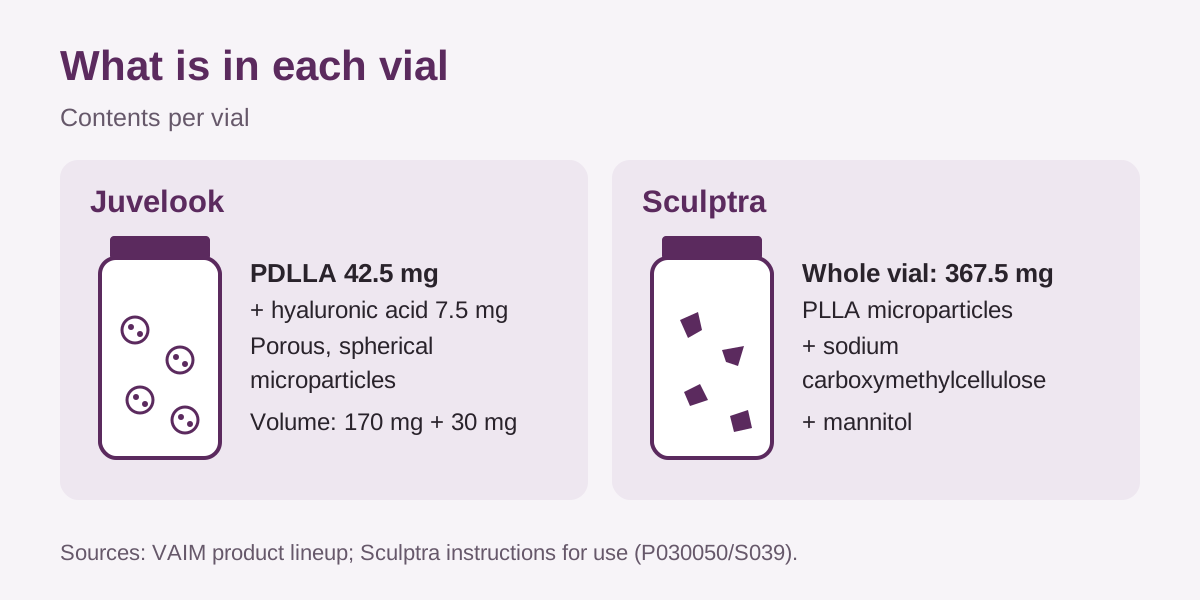
Juvelook and Sculptra are both polylactic acid microparticles supplied as powder, mixed with liquid before injection and meant to build their effect gradually, but the polymer and the rest of the vial differ. Standard Juvelook pairs 42.5 mg of porous poly-D,L-lactic acid (PDLLA) with 7.5 mg of hyaluronic acid; a Sculptra vial holds 367.5 mg in all, poly-L-lactic acid (PLLA) microparticles together with sodium carboxymethylcellulose and mannitol. One split-face trial of 33 adults compared Juvelook Volume with Sculptra on the nasolabial folds and found similar improvement over 24 weeks. The practical differences are how each is mixed, which layer it goes into and how many visits a course takes.
Product notes compiled by the Seoul Skin Boosters editors. Editorially updated: .
What is in each vial?
Standard Juvelook, made by VAIM in Korea, contains 42.5 mg of PDLLA and 7.5 mg of non-cross-linked hyaluronic acid; Juvelook Volume contains 170 mg and 30 mg (VAIM product lineup (accessed 24 October 2026)). VAIM makes its PDLLA particles by spraying an aqueous PDLLA solution into a cold vat, which gives porous, spherical microparticles, and uses the hyaluronic acid as a gel carrier (VAIM technology page (accessed 24 October 2026)).
Sculptra contains PLLA microparticles with sodium carboxymethylcellulose and mannitol, supplied freeze-dried in dose vials of 367.5 mg in all, two vials to a carton (Sculptra instructions for use (accessed 24 October 2026)). Authors of a 2026 comparison describe PDLLA as spongiform microspheres with a smooth outer shape and a porous inside, and PLLA as irregular, spiky particles with a densely packed inside [1].
How is each one mixed?
Sculptra’s label gives two ways to mix a vial: with 5 mL of sterile water, left to stand for at least two hours and usable for up to 72 hours, or with 8 mL, shaken and used straight away, with 1 mL of 2% lidocaine added just before injection if wanted. The suspension settles when it stands, so the vial is agitated again between syringes (Sculptra reconstitution steps).
Published Juvelook protocols mix further ahead. The under-eye study prehydrated the 50 mg vial with 6 mL of saline at least 24 hours before treatment and mixed it on a vortex mixer 30 minutes before injection [2]. The head-to-head trial mixed both Juvelook Volume and Sculptra in 6 mL of sterile water, left them for 24 hours, vortexed them for 30 minutes and added 2% lidocaine to a final 8 mL [1]. A Seoul price list names Juvelook sessions by volume, 3 cc or 4 cc, so ask how much liquid and how many vials your quote assumes.
Where is each one injected?
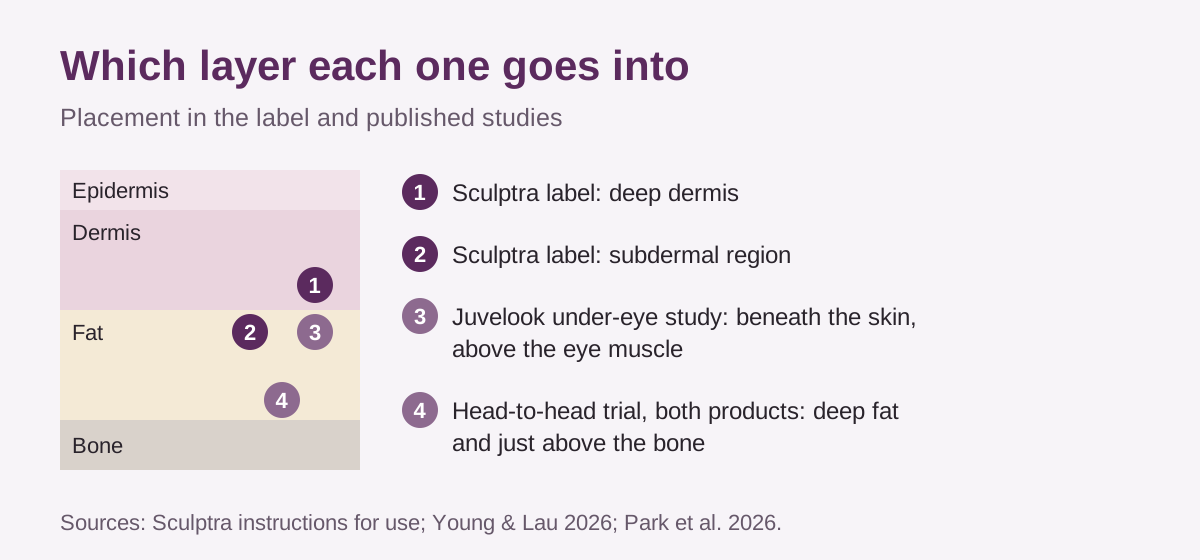
Sculptra’s label places the 5 mL mix in the deep dermis through a 26 G needle and the 8 mL mix in the subdermal region through a 25 G needle; in its cheek trial it was injected in the subdermal plane, subcutaneously or supraperiosteally, just above the bone (Sculptra injection steps and cheek study).
Juvelook’s Korean record describes injection under the skin. In the under-eye study, a 25 G or 27 G cannula placed 0.3–0.5 mL per lower eyelid beneath the skin, above the orbicularis oculi muscle [2]. In the head-to-head trial, both products went into the deep fat and the layer just above the bone of the nasolabial fold through a 23 G blunt-tip cannula [1].
What does each injection feel like?
PDLLA booster into the dermis
Mean pain on a visual analogue scale was 6.18 straight after each injection in a split-injection trial of 21 adults using a 32 G needle, and people under 40 scored this route higher [3].
PDLLA booster beneath the dermis
Mean pain on the same scale was 3.85 in the same trial [3].
Sculptra, in the 28 days after each session
In the cheek trial diaries, 83.9% of treated adults recorded pain or burning, 93.5% tenderness and 93.5% bruising; almost all symptoms were mild or moderate and most resolved within 14 days (FDA summary of the cheek trial (accessed 24 October 2026)).
What reduces discomfort
- Sculptra’s label allows 1 mL of 2% lidocaine in the 8 mL mix and a topical or local anaesthetic before injection.
- The head-to-head trial applied a lidocaine and prilocaine cream for 30 minutes and injected a mix containing 2% lidocaine [1].
- In the PDLLA pain trial, injections beneath the dermis scored lower than injections into it [3].
How many visits does a course take?
Sculptra’s label limits use to a single regimen of up to four sessions, three to four weeks apart, with at least four weeks between sessions for cheek lines and no re-evaluation sooner than three to four weeks after a session. Swelling from the water in the mix can look like full correction at the end of a session; it settles within hours to a few days, and improvement then builds over several weeks. The cheek trial assessed results at months 7, 9 and 12; its response rates are on the Sculptra vs Rejuran comparison.
The Juvelook under-eye study gave three sessions a month apart and assessed each one a month later; the largest change in improvement scores came between the first and second sessions, and the authors suggested maintenance every six months [2]. The head-to-head trial gave both products at weeks 0, 4 and 8 [1].
Both plans need return visits weeks apart. If you are visiting Seoul, ask before the first session whether the later ones can be done where you live with the same product, and how many vials a Sculptra course in Seoul would use.
What did the head-to-head trial find?
One randomised split-face trial compared the two directly. At four dermatology centres, 33 Korean adults received Juvelook Volume in one nasolabial fold and Sculptra in the other at weeks 0, 4 and 8. At week 24, wrinkle severity scores had fallen by a mean of 1.37 points on the Juvelook Volume side and 1.20 points on the Sculptra side, and global improvement scores were 1.85 and 1.62; the differences were not significant at any visit, and the authors concluded that the PDLLA product was non-inferior [1].
Of 20 participants who answered a follow-up survey, 70% had no preference between the sides. The trial tested Juvelook Volume rather than the standard vial, and VAIM, the maker of Juvelook, supported it [1].
What are the risks?
Sculptra’s label warns of delayed papules and nodules under the skin, often felt rather than seen, that appear days to months after injection and are slow to resolve. For PLLA, these lumps have been linked to incorrect reconstitution, an uneven suspension, injection that is too superficial and no massage afterwards [4]. In the Juvelook under-eye study, most women had mild swelling for a few hours to two days and two had temporary bruising [2]. In the head-to-head trial, most participants had mild swelling for three to four days with either product; one developed moderate swelling and tenderness on the Juvelook Volume side after the second session, which settled after injections of triamcinolone and hyaluronidase [1].
Both materials carry the rare risk of injection into a blood vessel. A 2026 systematic review counted two confirmed reports of visual loss after PLLA, two after PDLLA carried in carboxymethylcellulose and one after a PDLLA-HA product [5]. Changes in vision, signs of a stroke, whitening of the skin or unusual pain during or shortly after injection need prompt medical attention.
What do the US and Korean records say?
| Juvelook | Sculptra | |
|---|---|---|
| Polymer | PDLLA (poly-D,L-lactic acid) | PLLA (poly-L-lactic acid) |
| Other contents | Non-cross-linked hyaluronic acid | Sodium carboxymethylcellulose, mannitol |
| Vial contents as labelled | 42.5 mg PDLLA + 7.5 mg HA (Volume: 170 mg + 30 mg) | 367.5 mg dose vial: PLLA, sodium carboxymethylcellulose and mannitol together |
| Record | MFDS 제허17-972호, 21 December 2017 | FDA P030050, 3 August 2004; supplement S039, 25 April 2023 |
| Purpose or indication in the record | Injected under the skin to temporarily improve facial wrinkles in adults | Facial fat loss in people with HIV (2004); fine lines and wrinkles of the cheek in immune-competent people (2023) |
| Session plan | Under-eye study: three, a month apart; head-to-head trial: weeks 0, 4 and 8 | Label: up to four, three to four weeks apart |
The FDA record P030050, dated 3 August 2004, states that Sculptra “is intended for restoration and/or correction of the signs of facial fat loss (lipoatrophy) in people with human immunodeficiency virus”, and supplement P030050/S039, dated 25 April 2023, states that it “is indicated for correction of fine lines and wrinkles in the cheek region for use in immune-competent subjects”; the current label also lists shallow to deep nasolabial fold contour deficiencies and other facial wrinkles. Juvelook’s Korean record in the MFDS medical device database, 제허17-972호 dated 21 December 2017, is a Class 4 tissue-repair material of polylactide and hyaluronic acid injected under the skin to temporarily improve facial wrinkles in adults, and lists Juvelook, Juvelook Volume, Lenisna and Juvelook i among its product names (records checked 24 October 2026).
What does each cost in Seoul?
A Seoul dermatology price list gives Juvelook at KRW 150,000–300,000 for a 3 cc session and KRW 200,000–350,000 for a 4 cc session, and Juvelook Volume at KRW 500,000–700,000 per vial. The same list gives no Sculptra price, so ask for a written quote per vial and for the whole course. Prices checked 2026-10-24; confirm at consultation. Juvelook’s variants are compared on the Juvelook guide.
Is PDLLA the same as PLLA?
No. Both are polylactic acid, but PDLLA is poly-D,L-lactic acid and PLLA is poly-L-lactic acid. PDLLA has been described as porous microspheres and PLLA as irregular, densely packed particles [1], and the two products carry them differently: Juvelook with hyaluronic acid, Sculptra with sodium carboxymethylcellulose and mannitol.
Has any trial compared Juvelook with Sculptra?
One randomised split-face trial has compared them: Juvelook Volume against Sculptra on the nasolabial folds of 33 adults, with similar improvement over 24 weeks [1]. Standard Juvelook was not part of it.
Which needs fewer visits?
Why does Sculptra look full right after a session and then flatten?
Its label explains that the water in the mix and the injection itself cause swelling that looks like full correction at the end of a session. The swelling settles within hours to a few days, and the effect then builds over several weeks.
References (5)
Bibliographic records retrieved from PubMed (U.S. National Library of Medicine).
Park JY, Im DJ, Jeon HD, et al. A Split Face Study Comparing the Effect of a PDLLA Based Product and PLLA on the Nasolabial Fold (NLF). Skin Res Technol. 2026;32(1):e70324.
PubMed: 41532837Young SM, Lau EKH. Hybrid Biostimulator and Hyaluronic Acid Injectable for Tear Trough Rejuvenation. Aesthetic Plast Surg. 2026;50(13):5337-5343.
PubMed: 42098500Yi K, Rosellini I, Lau KH, et al. Comparative Pain Assessment of Intradermal Versus Subdermal Skin Booster Injections Using PDLLA: A Randomized, Double-Blinded Split-Injection Study. Aesthetic Plast Surg. 2026;50(11):4212-4217.
PubMed: 41501430Narins RS. Minimizing adverse events associated with poly-L-lactic acid injection. Dermatol Surg. 2008;34 Suppl 1:S100-4.
PubMed: 18547172Young SM, Goh ASC, Jeyabal P, Ooi ASH. Visual Loss in Biostimulator Injectables: A Review of Incidence, Risk Factors, Etiology and Management Proposal. Aesthetic Plast Surg. 2026;50(5):1994-2005.
PubMed: 41263987