Radiesse vs Sculptra: how calcium hydroxylapatite and poly-L-lactic acid differ
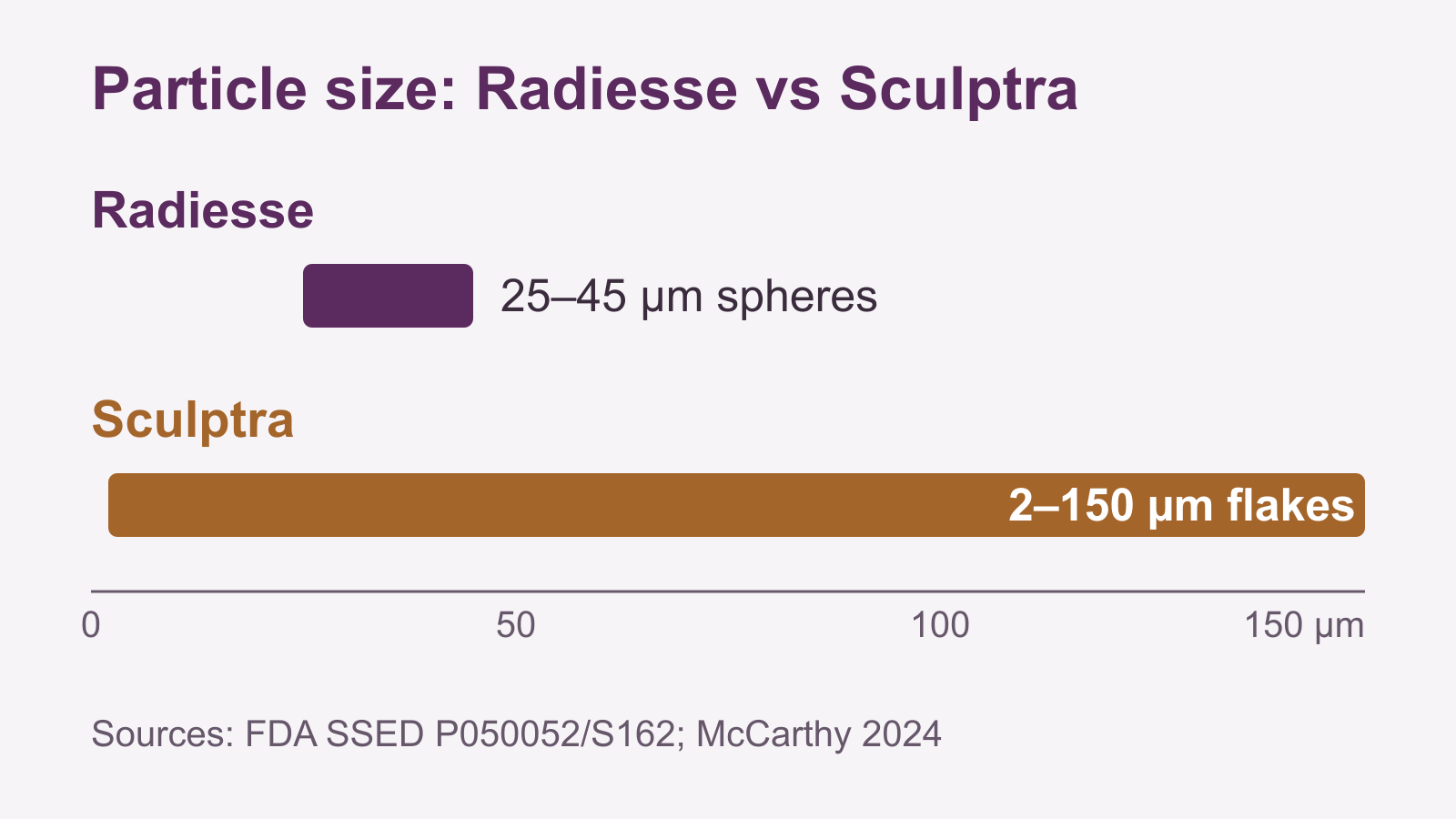
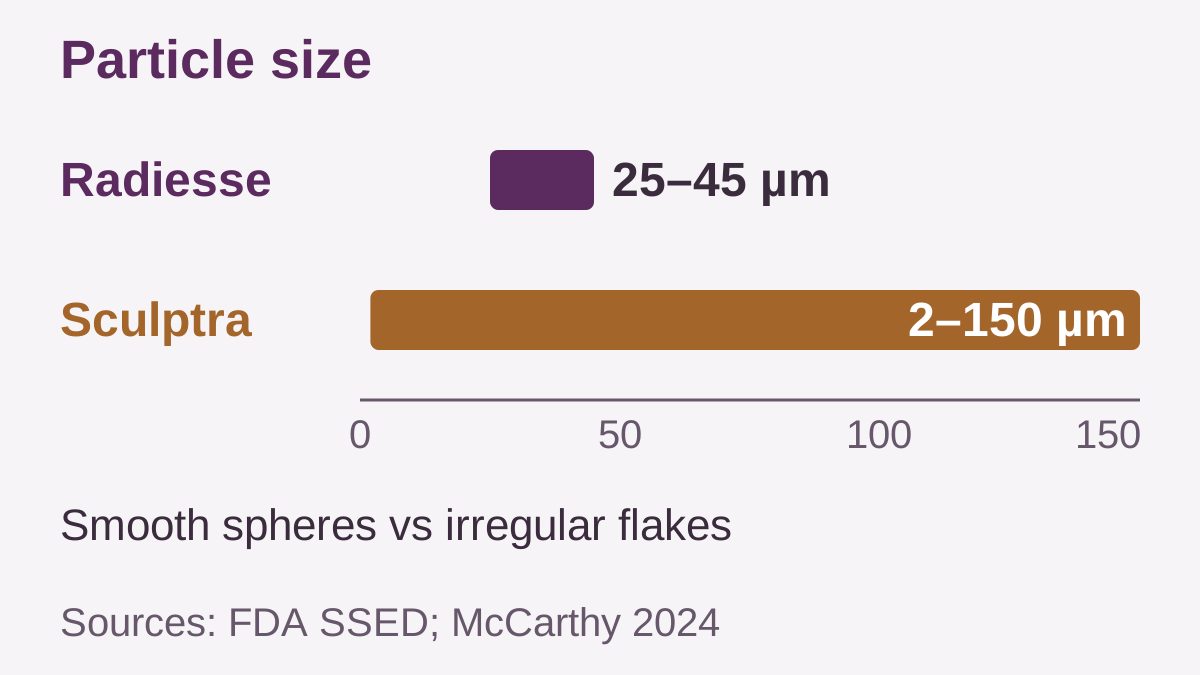
Radiesse and Sculptra both stimulate collagen, but on different timelines. Radiesse is calcium hydroxylapatite microspheres in a gel, which give some structural support straight away and then act as a scaffold for new collagen; Sculptra is poly-L-lactic acid microparticles that work gradually as the polymer breaks down.[1] Under the microscope, Radiesse particles are smooth spheres mostly 20 to 45 µm across, while Sculptra particles are irregular flakes of 2 to 150 µm.[2]
Product notes compiled by the Seoul Skin Boosters editors. Editorially updated: .
What is in each product?
Radiesse is synthetic calcium hydroxylapatite in a gel carrier of glycerin, sodium carboxymethylcellulose and water, with a particle size of 25 to 45 microns (FDA summary P050052/S162, opened 1 November 2026). Sculptra is poly-L-lactic acid microparticles with sodium carboxymethylcellulose and mannitol, supplied as a powder in vials that are mixed with sterile water before use (Sculptra instructions for use P030050/S039, opened 1 November 2026). Sculptra is compared with another polylactic acid product in Juvelook vs Sculptra.
A 2024 microscopy study measured both. Radiesse particles were smooth, uniform spheres; Sculptra particles were flakes that varied widely in shape and size, and a larger share of them were small enough to be taken up by immune cells. Two of the authors work for Merz, which makes Radiesse.[2]
How does each one build collagen?
A 2026 review describes calcium hydroxylapatite microspheres as giving immediate structural support while working as a scaffold for new collagen, and poly-L-lactic acid as acting through slow breakdown of the polymer and prolonged fibroblast stimulation, with improvement that builds gradually. Both work in the dermis and the connective tissue beneath it.[1]
Studies of how they work disagree on inflammation. In a 21-person randomised study with biopsies from the nasolabial fold at 90 days, poly-L-lactic acid switched on more genes for the matrix around cells, and calcium hydroxylapatite more genes in pro-inflammatory pathways.[3] In a laboratory study of human immune cells by researchers at Merz, poly-L-lactic acid raised several inflammatory signals that calcium hydroxylapatite did not.[4]
How was each product studied?
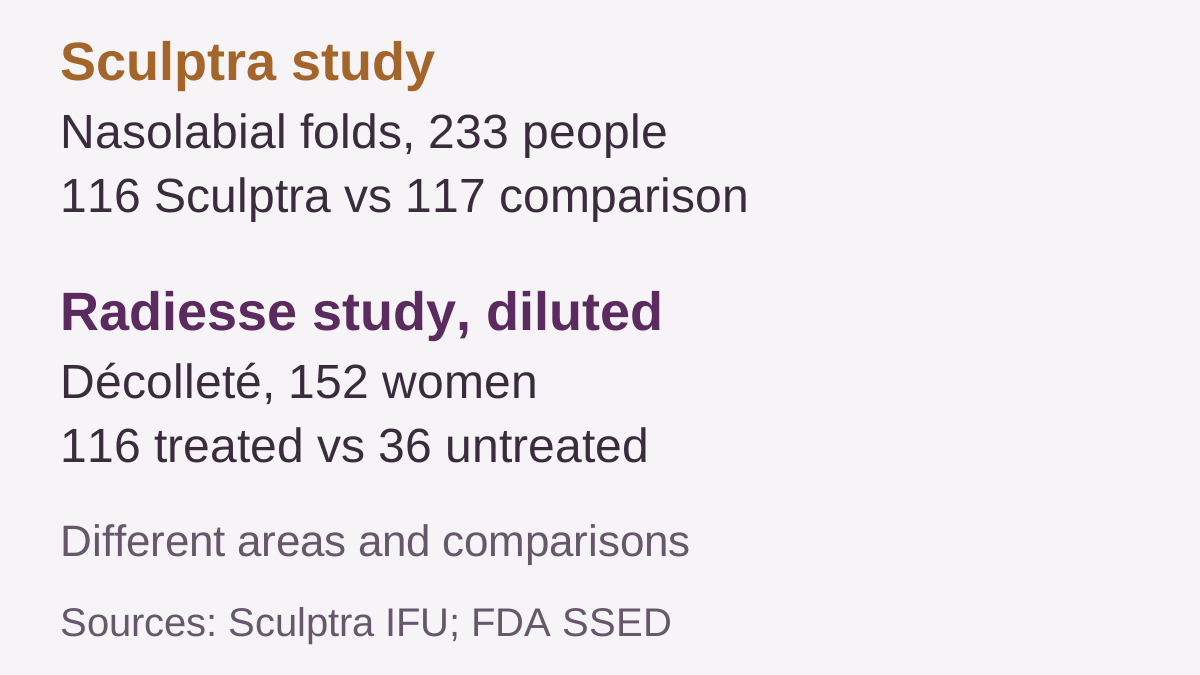
The Sculptra study in its instructions for use randomly assigned 233 people with nasolabial fold wrinkles at 10 US centres: 116 had Sculptra and 117 had a comparison filler, Cosmoplast. A blinded evaluation committee rated the folds on a wrinkle scale, and at 13 months the Sculptra group had improved more than the comparison group. Improvement was still observed at 25 months in the extension study; 106 Sculptra participants entered that phase and 95 completed it (Sculptra instructions for use, clinical studies).
The Radiesse trial in its FDA summary studied the diluted product on the décolleté. It randomly assigned 152 women 3 to 1: 116 were treated and 36 had no treatment until week 24. At week 24, 71.2% of treated women and 6.3% of untreated women were one grade or more better on a blinded rating (FDA summary, effectiveness results). The two trials studied different areas, preparations and comparison groups, so their results cannot be set against each other. More on the diluted form is in hyperdilute Radiesse.
Do Radiesse and Sculptra cause lumps?
Both can. In the controlled Sculptra study, nodules or papules appeared in 17.2% of people after Sculptra (Sculptra instructions for use, adverse events) and 12.8% after Cosmoplast; the median time to a nodule was 160 days after the first injection. Among the 106 participants entering the extension study, there were two new papules (1.9%) and one new nodule (0.9%). A later study across several facial areas found nodules or papules in 28.4% of people, most often in the marionette lines.
In the diluted Radiesse décolleté trial, a lump at the injection site was recorded as a treatment-related adverse event in 2.2% of women, and lumps or bumps noted in patient diaries were mostly mild (FDA summary, safety results). These percentages come from different study settings and cannot rank the two products on safety. A Brazilian series of 55 complications reported by ultrasound specialists found nodules in 89.1% of cases, usually appearing more than a month after treatment; the cases came from two poly-L-lactic acid brands, calcium hydroxylapatite and polycaprolactone, and only five resolved completely.[5]
Which one fits which goal?
Technique counts too: the 2026 review ties results to patient selection, dilution and precise placement in the subdermal plane.[1] To see what a cannula session looks like, there is a short film of Radiesse placed along the jawline with a cannula. For a Seoul quote, ask for it in writing with the product name, the number of syringes or vials and the number of sessions.
Which works faster, Radiesse or Sculptra?
A 2026 review describes calcium hydroxylapatite as giving immediate structural support and poly-L-lactic acid as working gradually as the polymer breaks down.[1]
How were Radiesse and Sculptra studied?
Sculptra was compared with another filler in 233 people with nasolabial fold wrinkles (Sculptra instructions for use); diluted Radiesse was compared with no treatment in 152 women with décolleté wrinkles (FDA summary P050052/S162).
Can Radiesse or Sculptra cause nodules?
Yes. Nodules or papules followed Sculptra in 17.2% of people in its controlled study (Sculptra instructions for use), and in a Brazilian series of 55 complications from several collagen stimulators, nodules made up 89.1% of cases.[5]
References (5)
Bibliographic records retrieved from PubMed (U.S. National Library of Medicine).
Somenek MT. Biostimulatory Injectables for Collagen Stimulation. Facial Plast Surg. 2026;42(5):601-606.
PubMed: 42297014McCarthy AD, Hartmann C, Durkin A, et al. A morphological analysis of calcium hydroxylapatite and poly-l-lactic acid biostimulator particles. Skin Res Technol. 2024;30(6):e13764.
PubMed: 38853456Waibel J, Nguyen TQ, Le JHTD, et al. Gene Analysis of Biostimulators: Poly-L-Lactic Acid Triggers Regeneration While Calcium Hydroxylapatite Induces Inflammation Upon Facial Injection. J Drugs Dermatol. 2025;24(1):34-40.
PubMed: 39761144Nowag B, Schäfer D, Hengl T, Corduff N, Goldie K. Biostimulating fillers and induction of inflammatory pathways: A preclinical investigation of macrophage response to calcium hydroxylapatite and poly-L lactic acid. J Cosmet Dermatol. 2024;23(1):99-106.
PubMed: 37593832Ianhez M, de Goés E Silva Freire G, Sigrist RMS, et al. Complications of collagen biostimulators in Brazil: Description of products, treatments, and evolution of 55 cases. J Cosmet Dermatol. 2024;23(9):2829-2835.
PubMed: 38693639